

 Back
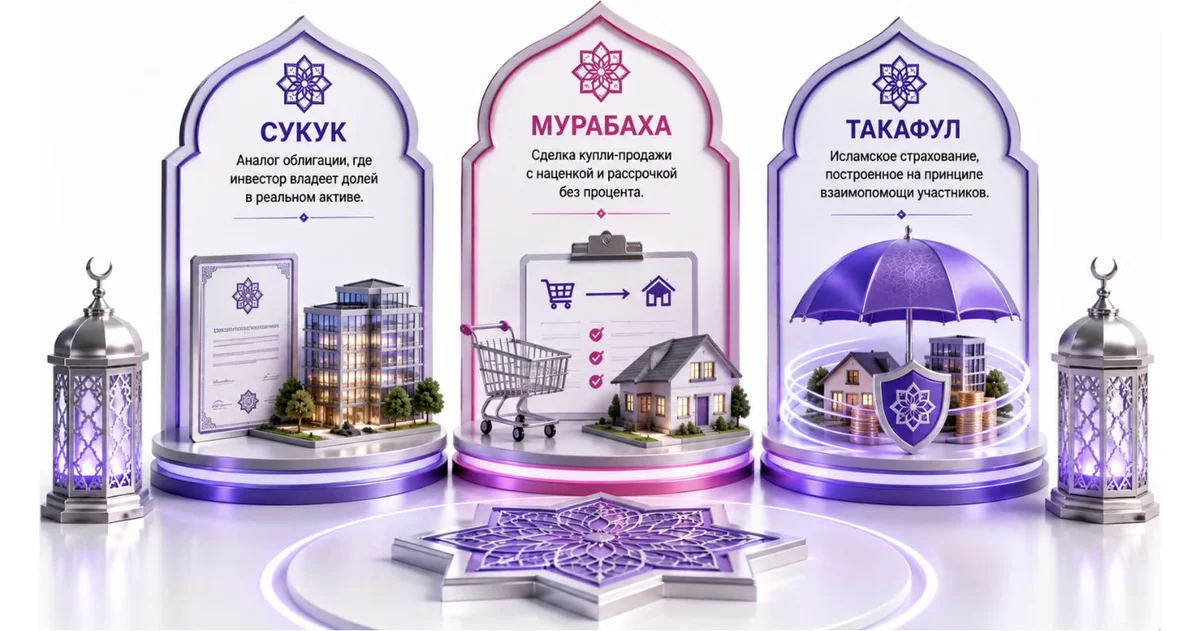
Terms of Islamic finance: Sukuk, Murabaha, Takaful
This article examines the main terms of Islamic finance that are most commonly encountered by investors interested in halal instruments.
What is Sukuk?
Sukuk is an instrument similar to a bond but structured differently: the holder of sukuk receives a share in a real asset or project (for example, rental property), and income is generated from the profit or rental payments of this asset — rather than from interest, as with ordinary bonds.
What is Murabaha?
A scheme for selling goods with a predetermined markup instead of issuing a loan with interest: the seller (for example, a bank) buys the necessary goods themselves and then resells them to the client at a higher price, with a transparent markup, fixed once during the transaction.
What is Takaful?
The Islamic alternative to insurance. Unlike classical insurance, where the insurance company assumes the client's risk for payment, in takaful, participants pool contributions into a common fund and mutually cover each other's losses, while a managing company administers the fund for a separate fee rather than earning from the risk itself.
What is Riba?
Interest — the charge of a predetermined premium on a loan merely for the use of money, without any connection to real assets or risk-sharing. Riba is prohibited in Islamic finance, and the avoidance of riba explains the structure of most of the instruments mentioned above.
What is Gharar?
Excessive uncertainty or ambiguity in the terms of a transaction. It is considered undesirable in Islamic finance, so contracts aim to be as transparent as possible: the price, subject of the transaction, and terms must be clearly understood by both parties in advance.
What are Mudarabah and Musharakah?
Two forms of partnerships with profit and loss sharing. In mudarabah, one partner provides capital, while the other contributes labor and management, and profits are divided according to a predetermined ratio. In musharakah, both partners contribute capital and jointly participate in management and outcomes.
This material is for informational purposes only, does not constitute a religious ruling (fatwa), and is not an individual investment recommendation. The meanings of terms may be refined depending on the school of law and the specific structure of the transaction.

Calls within Tajikistan are free
Investments
Information




The information provided is for informational purposes only and should not be considered as an offer to buy or sell foreign currency, securities and/or other financial instruments. The information presented on this website is not an individual investment recommendation. Financial instruments or transactions mentioned in this section may not be suitable for you, may not correspond to your investment profile, financial situation, investment experience, knowledge, investment objectives, attitude to risk and profitability.
LLC "Exchange Broker" does not guarantee and does not promise future profitability of investments, does not guarantee the reliability of possible investments and the stability of possible income. Investment results in the past do not guarantee income in the future.
LLC "Exchange Broker" is not responsible for possible investor losses in the event of transactions and investments in financial instruments, and also does not guarantee the return, effectiveness and profitability of investments.
LLC "Exchange Broker" hereby informs that it operates in the securities market in accordance with the following professional participant licenses issued by the Ministry of Finance of the Republic of Tajikistan: depository activity No.010/25 dated 25.06.2025; brokerage activity No.007/25 dated 25.06.2025; dealer activity No.008/25 dated 25.06.2025 and securities management activity No.009/25 dated 25.06.2025, and also informs about the risk of a conflict of interest, including as a result of combining various types of professional activity in the securities market.