

 Back
Limit Order on the Stock Exchange: What It Is and How to Use It
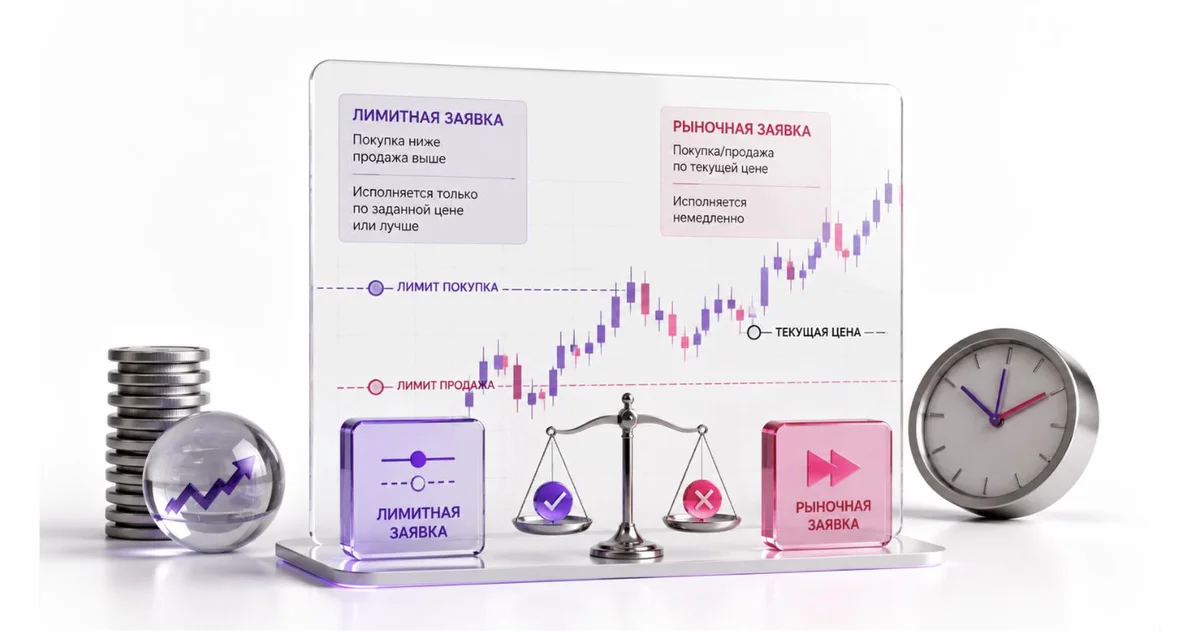
A limit order is an order to buy or sell an asset not at any price, but strictly at your specified price or better.
How a limit order differs from a market order
A market order is executed immediately at the current market price — you get execution speed, but you don't control the exact price of the transaction. A limit order, on the other hand, will only be executed when the asset's price reaches the level you specified or better — you sacrifice the guarantee of immediate execution for control over the price.
How it works in practice
When buying, you specify the maximum price you are willing to pay: the order will be executed at that price or lower. When selling, you specify the minimum price you are willing to accept: the order will be executed at that price or higher. If the market does not reach the desired level, the order simply remains unexecuted until you cancel it or its term expires.
When a limit order is useful
It is useful if you are targeting a specific entry or exit price and do not want to buy or sell at the current market price if it does not suit you. Limit orders also reduce the risk of execution at an unexpectedly disadvantageous price in a volatile market.
What is important to consider
The main compromise is the lack of execution guarantee: if the price never reaches the specified level, the order can remain unexecuted indefinitely. Limit orders are available in the "Stock Broker" trading terminal when placing a trade for stocks and other catalog instruments.
This material is for informational purposes only and is not an individual investment recommendation.

Calls within Tajikistan are free
Investments
Information




The information provided is for informational purposes only and should not be considered as an offer to buy or sell foreign currency, securities and/or other financial instruments. The information presented on this website is not an individual investment recommendation. Financial instruments or transactions mentioned in this section may not be suitable for you, may not correspond to your investment profile, financial situation, investment experience, knowledge, investment objectives, attitude to risk and profitability.
LLC "Exchange Broker" does not guarantee and does not promise future profitability of investments, does not guarantee the reliability of possible investments and the stability of possible income. Investment results in the past do not guarantee income in the future.
LLC "Exchange Broker" is not responsible for possible investor losses in the event of transactions and investments in financial instruments, and also does not guarantee the return, effectiveness and profitability of investments.
LLC "Exchange Broker" hereby informs that it operates in the securities market in accordance with the following professional participant licenses issued by the Ministry of Finance of the Republic of Tajikistan: depository activity No.010/25 dated 25.06.2025; brokerage activity No.007/25 dated 25.06.2025; dealer activity No.008/25 dated 25.06.2025 and securities management activity No.009/25 dated 25.06.2025, and also informs about the risk of a conflict of interest, including as a result of combining various types of professional activity in the securities market.