

 Back
Islamic Bank: How It Differs from a Conventional Bank
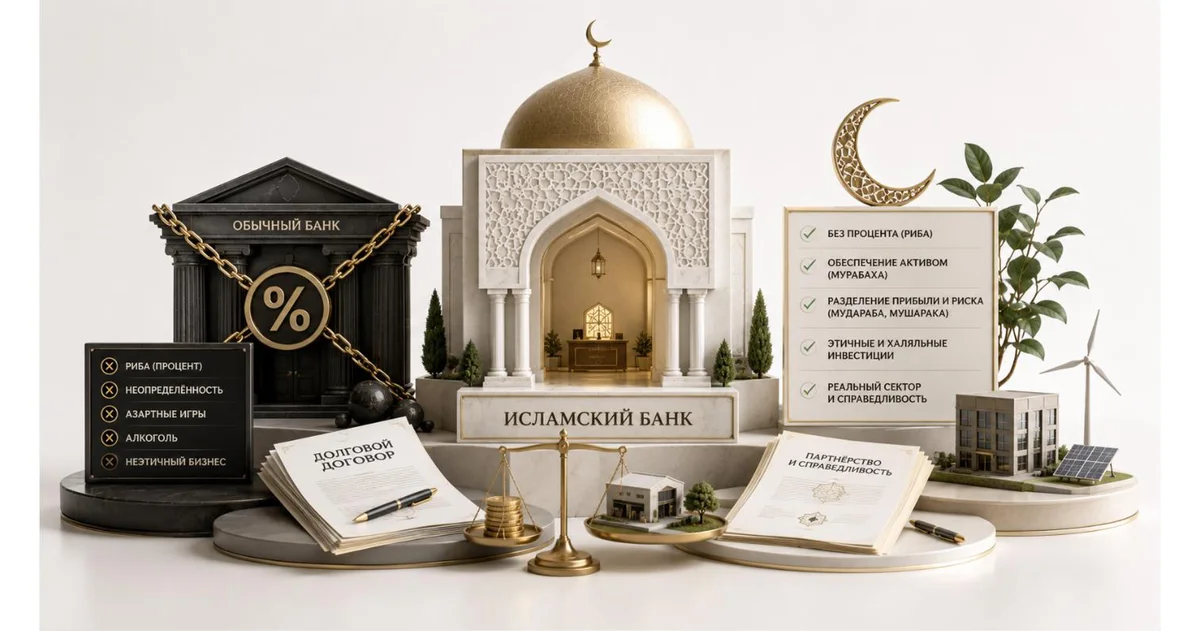
An Islamic bank operates on the same basic functions as a conventional bank — accepting deposits, financing, payments, — but it does so based on principles that prohibit interest rates and require a real economic basis for each transaction.
Main difference: prohibition of riba (interest)
A conventional bank earns from the spread between deposit rates and loan rates. In Islamic finance, interest (riba) is prohibited: the bank cannot simply lend money for interest. Instead, schemes based on real assets or profit and risk sharing are used — for example, murabaha (the bank buys a product and sells it to the client with a markup rather than lending for interest) or mudaraba and musharaka (the bank and the client share the profit and loss from a joint project).
Risk sharing instead of guaranteed interest
In the classical model of an Islamic bank, the depositor's yield is not fixed in advance but depends on the bank's investments, meaning the depositor partially shares the risk rather than just receiving a guaranteed interest. In practice, many Islamic banks offer products that are close in predictability to conventional deposits, but the structure of the deal formally remains based on profit sharing, not interest.
Prohibition on financing certain sectors
An Islamic bank does not finance businesses related to alcohol, gambling, pork, and other activities prohibited in Islam. Compliance with these principles is overseen by the bank’s Sharia supervisory board.
How it relates to «Stock Broker»
«Stock Broker» is not an Islamic bank but a broker offering access to a catalog of halal stocks selected according to AAOIFI standards, and services of a certified AAOIFI Sharia expert on staff; the list of approved securities is reviewed quarterly. The separate service «halal brokerage account» is currently suspended — the current status should be checked in the app before opening an account.
The material is for informational purposes only and is not a religious ruling (fatwa) or individual investment advice. For questions on the compliance of specific products with Sharia norms, it is recommended to consult with a qualified Islamic scholar.

Calls within Tajikistan are free
Investments
Information




The information provided is for informational purposes only and should not be considered as an offer to buy or sell foreign currency, securities and/or other financial instruments. The information presented on this website is not an individual investment recommendation. Financial instruments or transactions mentioned in this section may not be suitable for you, may not correspond to your investment profile, financial situation, investment experience, knowledge, investment objectives, attitude to risk and profitability.
LLC "Exchange Broker" does not guarantee and does not promise future profitability of investments, does not guarantee the reliability of possible investments and the stability of possible income. Investment results in the past do not guarantee income in the future.
LLC "Exchange Broker" is not responsible for possible investor losses in the event of transactions and investments in financial instruments, and also does not guarantee the return, effectiveness and profitability of investments.
LLC "Exchange Broker" hereby informs that it operates in the securities market in accordance with the following professional participant licenses issued by the Ministry of Finance of the Republic of Tajikistan: depository activity No.010/25 dated 25.06.2025; brokerage activity No.007/25 dated 25.06.2025; dealer activity No.008/25 dated 25.06.2025 and securities management activity No.009/25 dated 25.06.2025, and also informs about the risk of a conflict of interest, including as a result of combining various types of professional activity in the securities market.