


 Back
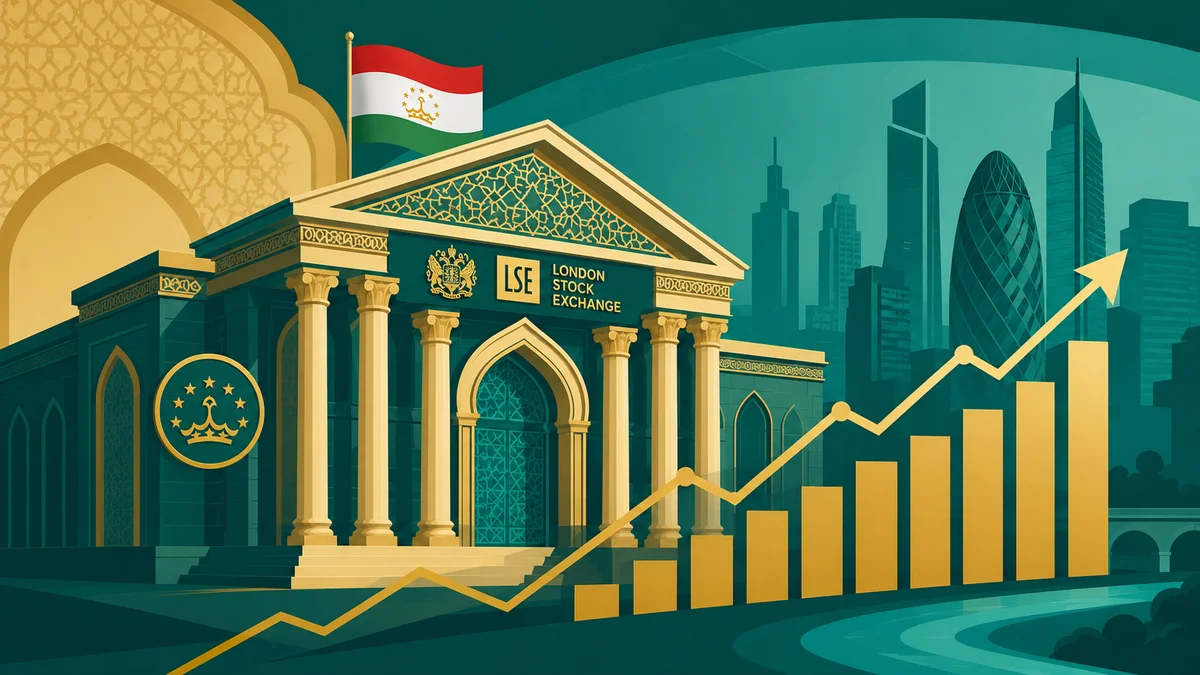
Tajikistan has debuted on the London Stock Exchange with bonds in somoni.
On July 20, the International Finance Corporation (IFC) issued bonds pegged to the Tajik somoni for the first time on the London Stock Exchange. This might sound like news for officials and bankers, but it actually affects anyone whose savings or business is tied to the somoni. Let's break down what happened, what results from this—and what does not.
What happened
The IFC (International Finance Corporation) is part of the World Bank Group, which finances businesses in developing countries and has one of the highest credit ratings in the world. On July 20, it issued bonds on the London Stock Exchange for the first time, which are linked to the value of the somoni (TJS). Simply put, international investors lent money in amounts tied to the somoni, and the IFC collected these funds to then direct them as financing within Tajikistan—in somoni, not dollars.
This was reported by the State Committee on Investments and State Property Management of the Republic of Tajikistan. According to their data, the raised funds will be used to support small and medium businesses, enterprises owned by women, and to finance energy-efficient housing and climate projects.
Why this is not ordinary news
Until now, the somoni had never been a currency for borrowing money on the international capital market. The very fact of issuance is essentially a sign that large international investors are willing to take on risk linked to the somoni, not just the dollar or euro. The State Committee on Investments directly called this a step towards developing the capital market and increasing the investment attractiveness of the country.
This fits into the overall picture of 2026: Tajikistan's exports have grown by almost two-thirds in the first half of the year, foreign investment in Dushanbe has reached 1.6 billion somoni for the same period. Individually, these are news items from different departments, but together they signal that the country is trying to integrate more closely into international capital markets.
There is also a practical effect. When a local business takes a loan in dollars but earns in somoni, it bears the currency risk: if the dollar rises, the debt becomes more expensive in somoni terms. Financing originally pegged to the somoni removes this layer of risk for those who can access it.
What this does not mean
It is important not to confuse this news event with a personal investment opportunity.
This does not mean that a private investor in Dushanbe or Khujand can simply come and buy this IFC bond issue. This is an institutional instrument intended for large international investors; the conditions for retail access for investors from Tajikistan are not disclosed in public sources—if precise information becomes available, we will verify and update the material.
This is not Tajikistan’s sovereign debt. The bonds are issued by the IFC, a supranational organization with its own rating, not by the government of the republic, and this difference is crucial for assessing risk.
It is not a guarantee that the money will quickly reach specific businesses. Such programs usually work through partner banks on the ground, and the timing and mechanics of this particular issue are not disclosed in the State Committee's announcement.
What can be done now
If you have a small or medium-sized business, especially one involving women, you should watch for announcements from Tajik banks that may become IFC partners in the somoni financing channel.
If you just keep your savings in somoni—this is not a signal of where to put your money, but an indication that the stability and predictability of the somoni is becoming the focus of serious international institutions, which indirectly reduces some currency risks in the economy as a whole.
The material is for informational purposes only and does not constitute individual investment advice. The financial instruments mentioned in the article are not issued or sold by the Brokerage Broker—the aim of the material is to explain the context, not to propose a specific transaction.

Calls within Tajikistan are free
Investments
Information




The information provided is for informational purposes only and should not be considered as an offer to buy or sell foreign currency, securities and/or other financial instruments. The information presented on this website is not an individual investment recommendation. Financial instruments or transactions mentioned in this section may not be suitable for you, may not correspond to your investment profile, financial situation, investment experience, knowledge, investment objectives, attitude to risk and profitability.
LLC "Exchange Broker" does not guarantee and does not promise future profitability of investments, does not guarantee the reliability of possible investments and the stability of possible income. Investment results in the past do not guarantee income in the future.
LLC "Exchange Broker" is not responsible for possible investor losses in the event of transactions and investments in financial instruments, and also does not guarantee the return, effectiveness and profitability of investments.
LLC "Exchange Broker" hereby informs that it operates in the securities market in accordance with the following professional participant licenses issued by the Ministry of Finance of the Republic of Tajikistan: depository activity No.010/25 dated 25.06.2025; brokerage activity No.007/25 dated 25.06.2025; dealer activity No.008/25 dated 25.06.2025 and securities management activity No.009/25 dated 25.06.2025, and also informs about the risk of a conflict of interest, including as a result of combining various types of professional activity in the securities market.