

 Back
Back
Basics of Investing: Stocks, Bonds, and ETFs
The world of investments offers many tools for capital growth. For a beginner investor, it is important to understand the key differences between the main ones. This guide explains three fundamental assets: stocks, bonds, and ETFs, so you can make an informed choice when forming your investment portfolio.
Stocks: A Share in Business and Potential High Growth
A stock is a security that gives you the right to own a small part of a company. By purchasing a stock, you become a shareholder and essentially a co-owner of the business. This grants you the right to a portion of the company's profits and, in some cases, voting rights at shareholder meetings.
How to Earn from Stocks
The main way to earn from stocks is through price appreciation. If a company is successful, its stock price rises, and you can sell it for a profit. For example, if you bought a company's stock for $100, and a year later it's worth $150, you gained $50 on each share.
Moreover, many companies pay dividends—a portion of their profits distributed among shareholders. This can be an additional income source, even if the stock price doesn’t increase.
Advantages of Stocks
Stocks offer several significant advantages for investors. Firstly, they have high return potential. Historically, stocks grow on average by 10% a year, which significantly exceeds inflation. Secondly, stocks are easy to buy and sell—they have high liquidity, meaning you can quickly convert them to cash. Thirdly, by investing in stocks, you participate in the growth of the company and share in its success.
Disadvantages and Risks of Stocks
However, stocks are considered a riskier tool compared to bonds. Their price can fluctuate significantly based on the economic situation, company news, and market sentiment. An investor can lose part or even all of their investment if the company goes bankrupt. Moreover, analyzing companies requires time and knowledge, which can be challenging for beginners.
Who Stocks Are Suitable For
Stocks are best suited for investors with a high tolerance for risk, who are ready for price fluctuations and have a long-term investment horizon (at least 5-10 years). They are also suitable for people who are willing to spend time analyzing companies and tracking financial news.
Bonds: Debt Obligations and Predictable Income
A bond is essentially a debt note. By purchasing a bond, you lend money to a company or government (the issuer). In return, the issuer is obligated to return the bond's face value to you within a certain period and periodically pay interest—coupons.
How Bonds Work
Imagine you bought a bond with a face value of $1000 with a 5% coupon and a maturity of 5 years. This means each year you will receive $50 (5% of $1000), and after 5 years, your $1000 will be returned. Thus, over 5 years, you receive $250 in coupons plus your initial capital back.
Types of Bonds
Bonds are divided into two main types. Government bonds (Treasuries) are issued by the government and are considered the most reliable as governments rarely default. However, they offer lower yields. Corporate bonds are issued by companies and can offer higher returns but come with higher risks, as a company can go bankrupt. A corporate bond's reliability depends on the rating given by rating agencies.
Advantages of Bonds
The main advantage of bonds is the predictability of income. You know the size of coupon payments and the redemption date in advance. This makes bonds a more conservative and reliable tool. Bonds also have good liquidity, allowing them to be sold at any time. Additionally, bonds help protect capital and provide stable passive income, which is especially important for people living off investment income.
Disadvantages of Bonds
The primary disadvantage of bonds is the lower yield compared to stocks. Furthermore, bonds are subject to interest rate risk: if rates rise, existing bond values fall. There is also a risk of default—the company or government may not pay coupons or return the face value. Finally, inflation can reduce the real value of your income if coupons are below the inflation rate.
Criteria for Choosing Bonds
When selecting bonds, pay attention to a few key parameters. The rating should be no lower than BBB (according to Standard & Poor's classification), indicating the issuer's reliability. The maturity date impacts risk and yield—longer terms usually offer higher yields. The coupon size determines your regular income. Finally, it is crucial to assess the issuer's reliability and financial health.
Who Bonds Are Suitable For
Bonds are ideal for conservative investors who prefer stability and predictability. They are also suitable for retirees and people who need regular income. Bonds are also recommended for those looking to diversify their portfolio and reduce overall risk.
ETFs: Instant Diversification in One Tool
An ETF (Exchange-Traded Fund) is a ready-made portfolio composed of various assets (stocks, bonds, commodities) that trades on an exchange as one security. By purchasing a single ETF share, you invest in all the companies within its composition simultaneously.
How ETFs Work
An asset management company creates a fund and buys securities according to a certain index or strategy. For example, an ETF that follows the S&P 500 index allows you to buy shares in the 500 largest US companies with one click. Investors buy fund shares, and as the fund's asset value increases, so does the value of shares. Investors can sell shares at any time and earn a profit.
Types of ETFs
There are many different types of ETFs. Index ETFs track a specific index, like the S&P 500 or NASDAQ. Sectoral ETFs invest in companies from a specific sector, such as technology or healthcare. Regional ETFs invest in companies from a specific region or country. Currency ETFs track currency pairs. Each type of ETF has its own risk and return profile.
Advantages of ETFs
ETFs offer many advantages for investors. Firstly, they provide instant diversification—investment into many companies, significantly reducing risk. Secondly, ETFs have low fees—lower than mutual funds or managed portfolios. Thirdly, they have a low entry threshold—you can start with a small amount, often from 6 rubles per share. Fourthly, ETFs are easy to buy and sell on the exchange like regular stocks. Fifthly, they are fully transparent—all fund operations are open to investors. Finally, ETFs are reliable—assets are stored in a specialized depository, and the asset management company's activities are regulated.
Disadvantages of ETFs
Despite the many advantages, ETFs do have some drawbacks. Firstly, they offer limited flexibility—the fund follows an index and cannot outperform it. Secondly, there are management company fees, which reduce returns. Thirdly, ETF performance depends on the quality of management—if poorly managed, it can affect results.
Who ETFs Are Suitable For
ETFs are ideal for beginner investors who lack experience analyzing companies. They are also suitable for people without time to monitor a portfolio. ETFs are recommended for conservative investors looking to reduce risk through diversification. Finally, ETFs are suitable for those who want to invest in indices and achieve returns close to market averages.
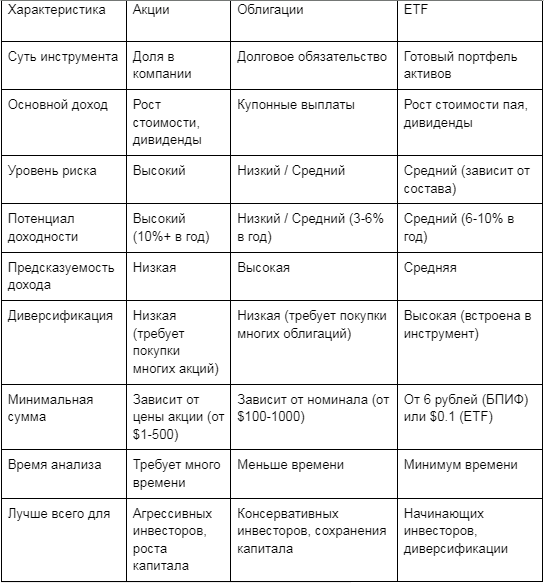
Stock vs. Bonds vs. ETFs Comparison Chart
How to Choose an Instrument Based on Your Goals
The choice between stocks, bonds, and ETFs depends on several factors: your financial goals, investment timeframe, risk appetite, and the amount of time you're willing to spend managing your portfolio.
For Conservative Investors
If you prefer stability and predictability, it's recommended to allocate: 70-80% in bonds (government and high-rated corporate), 20-30% in ETFs (index funds), and minimal in individual stocks. This portfolio ensures stable income and capital protection.
For Moderate Investors
If you're willing to accept moderate risk and want a balance between growth and stability, it's recommended to allocate: 40-50% in bonds, 30-40% in ETFs (mixed funds), and 10-20% in individual stocks (stocks of large, stable companies). This portfolio provides capital growth with an acceptable level of risk.
For Aggressive Investors
If you're young, have a long-term investment horizon, and are ready for high risk, it's recommended to allocate: 20-30% in bonds (for portfolio stabilization), 30-40% in ETFs (including sectoral and regional), and 30-50% in individual stocks (including growth stocks). This portfolio ensures maximum growth potential.
Age Rule for Asset Allocation
There's a simple rule to help determine optimal distribution between stocks and bonds:
Bond allocation (%) = Your age
Stock allocation (%) = 100 - Your age
For example, if you're 30 years old, it's recommended to invest 30% in bonds and 70% in stocks/ETFs. If you're 60, then 60% in bonds and 40% in stocks/ETFs. This rule is based on the idea that risk should be reduced with age.
Practical Tips for Beginner Investors
If you're just starting your investment journey, here are some practical tips:
Start with ETFs. For beginners, ETFs are an ideal starting tool. They provide diversification, have low fees, and do not require in-depth company analysis.
Invest regularly. Instead of investing a lump sum at once, invest small amounts regularly (monthly or quarterly). This reduces risk and allows price averaging.
Diversify your portfolio. Do not put all your eggs in one basket. Spread investments across different instruments and sectors.
Have a long-term horizon. Investing is a long-term strategy. Do not seek quick profits. Historically, markets grow in the long run.
Constantly learn. Read investment books, listen to podcasts, watch videos. The more you know, the better decisions you'll make.
Do not panic during a market downturn. Market drops are a normal part of investing. Do not sell in panic. Often this is the best time to buy.
Conclusion
Stocks, bonds, and ETFs are three fundamental tools that every investor should understand. Stocks offer high growth potential but high risk. Bonds ensure stability and predictable income. ETFs offer the best of both worlds—diversification, low fees, and ease of use.
A wise combination of these tools in your portfolio, tailored to your goals and risk tolerance, will help you achieve the optimal balance between returns and safety. Remember, investing is a marathon, not a sprint. Start small, keep learning, and gradually increase the complexity of your investment strategy.

Calls within Tajikistan are free
Investments
Information




The information provided is for informational purposes only and should not be considered as an offer to buy or sell foreign currency, securities and/or other financial instruments. The information presented on this website is not an individual investment recommendation. Financial instruments or transactions mentioned in this section may not be suitable for you, may not correspond to your investment profile, financial situation, investment experience, knowledge, investment objectives, attitude to risk and profitability.
LLC "Exchange Broker" does not guarantee and does not promise future profitability of investments, does not guarantee the reliability of possible investments and the stability of possible income. Investment results in the past do not guarantee income in the future.
LLC "Exchange Broker" is not responsible for possible investor losses in the event of transactions and investments in financial instruments, and also does not guarantee the return, effectiveness and profitability of investments.
LLC "Exchange Broker" hereby informs that it operates in the securities market in accordance with the following professional participant licenses issued by the Ministry of Finance of the Republic of Tajikistan: depository activity No.010/25 dated 25.06.2025; brokerage activity No.007/25 dated 25.06.2025; dealer activity No.008/25 dated 25.06.2025 and securities management activity No.009/25 dated 25.06.2025, and also informs about the risk of a conflict of interest, including as a result of combining various types of professional activity in the securities market.