

 Back
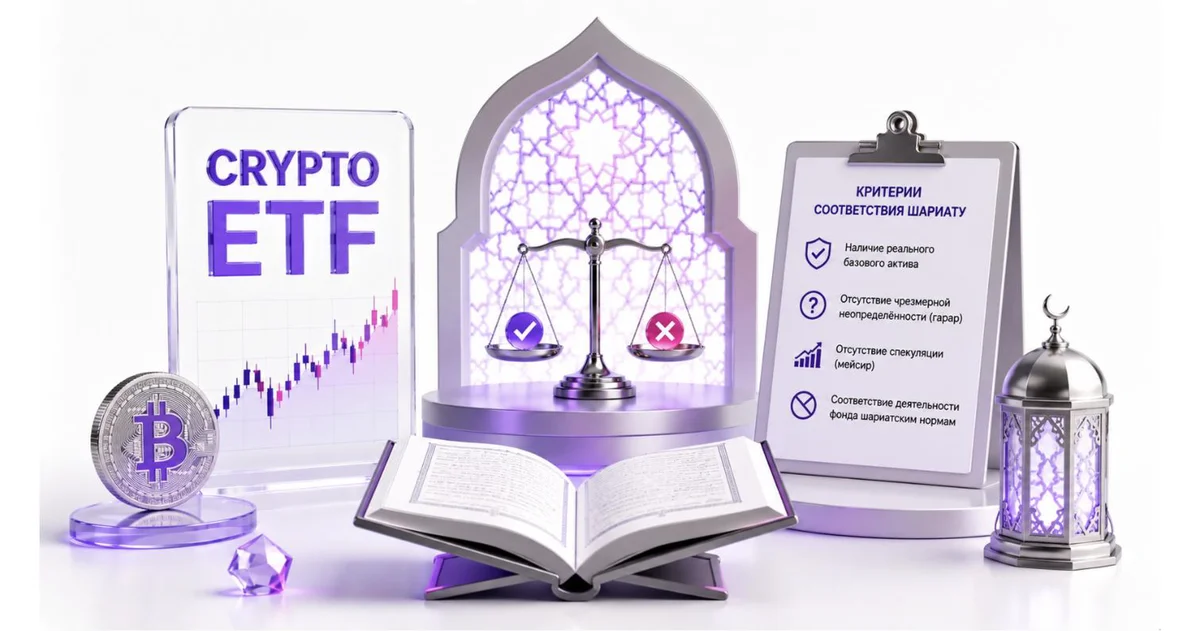
Crypto-ETF and Islam: What Scholars Say
There is no definitive, universally accepted answer to the question "is cryptocurrency halal" in Islamic finance yet — the opinions of authoritative scholars diverge, and this also extends to cryptocurrency ETFs.
What the disagreements are about
Some Islamic scholars consider cryptocurrency a permissible form of property (maal), which can be bought and sold as long as the transaction is not related to prohibited activities. Others point to the high level of speculation and uncertainty (gharar) as grounds for caution or outright prohibition, as well as the lack of tangible backing for cryptocurrencies, unlike stocks that represent a share in a real business. An agreed-upon position, recognized by all schools and councils, does not exist at present.
Does the form of ETF change anything
A crypto-ETF adds another layer to this discussion: the investor does not hold cryptocurrency directly but buys a share of a regulated fund that itself holds the asset on its balance sheet. For some scholars, this does not resolve the initial questions regarding the nature of the underlying asset; for others, the regulated, transparent structure of the fund is a separate factor that should be considered independently of direct cryptocurrency ownership. Different councils and experts may reach different conclusions even when discussing the same product.
What this means in practice
There is no definitive fatwa applicable to all situations and all investors — the judgment may depend on the specific school of thought, the specific product, and interpretation. For those for whom compliance with Sharia principles is crucially important, it is worth discussing the specific instrument with a qualified Islamic scholar rather than relying on general opinions on the "crypto and Islam" topic.
This material is for informational purposes only, is not a religious ruling (fatwa), and does not reflect a definitive position on the issue. The material is also not an individual investment recommendation.

Calls within Tajikistan are free
Investments
Information




The information provided is for informational purposes only and should not be considered as an offer to buy or sell foreign currency, securities and/or other financial instruments. The information presented on this website is not an individual investment recommendation. Financial instruments or transactions mentioned in this section may not be suitable for you, may not correspond to your investment profile, financial situation, investment experience, knowledge, investment objectives, attitude to risk and profitability.
LLC "Exchange Broker" does not guarantee and does not promise future profitability of investments, does not guarantee the reliability of possible investments and the stability of possible income. Investment results in the past do not guarantee income in the future.
LLC "Exchange Broker" is not responsible for possible investor losses in the event of transactions and investments in financial instruments, and also does not guarantee the return, effectiveness and profitability of investments.
LLC "Exchange Broker" hereby informs that it operates in the securities market in accordance with the following professional participant licenses issued by the Ministry of Finance of the Republic of Tajikistan: depository activity No.010/25 dated 25.06.2025; brokerage activity No.007/25 dated 25.06.2025; dealer activity No.008/25 dated 25.06.2025 and securities management activity No.009/25 dated 25.06.2025, and also informs about the risk of a conflict of interest, including as a result of combining various types of professional activity in the securities market.