

 Back
Back
Trader Psychology: How Not to Lose Your Head in the Market
Introduction
Success in trading depends not only on the ability to read charts and analyze the market. Often, the decisive factor is psychology. Emotions such as fear and greed can cause even the most experienced analyst to make irrational decisions and lose money. This article will help you understand how to manage your emotions, avoid typical psychological traps, and keep a cool head in a volatile market.
The Two Main Enemies of a Trader: Fear and Greed
The root of most trading mistakes lies in two powerful emotions: fear and greed. They are part of human nature, but in trading, they can become your worst enemies.
Fear
Fear in trading manifests itself in different ways, but it always leads to losses or missed opportunities:
• Fear of missing out (FOMO): You see an asset rapidly growing and in panic buy it at its peak, afraid of missing profit. Typically, this is followed by a correction, and you end up with a loss.
• Fear of losses: You close a profitable trade too early at the slightest pullback, not allowing profits to grow. Alternatively, paralyzed by fear, you cannot enter a trade even when all signals point to an excellent opportunity.
• Fear of admitting a mistake: You hold on to a losing position hoping the price will turn around instead of taking a small loss. Often, this leads to catastrophic losses.
Research: An analysis of over 30 million real trades conducted by DailyFX showed that the main mistake of traders is holding losing positions for too long.
Greed
Greed drives traders to take unjustified risks in pursuit of excessive profits:
• Overtrading: You make too many trades trying to catch every market move, leading to high commissions and emotional burnout.
• Excessive position size: You risk too much of your capital on one trade, hoping to hit the jackpot. One such trade can wipe out your account.
• "Revenge" trading: After a losing trade, you try to recover immediately by doubling risks, which almost always leads to even greater losses.
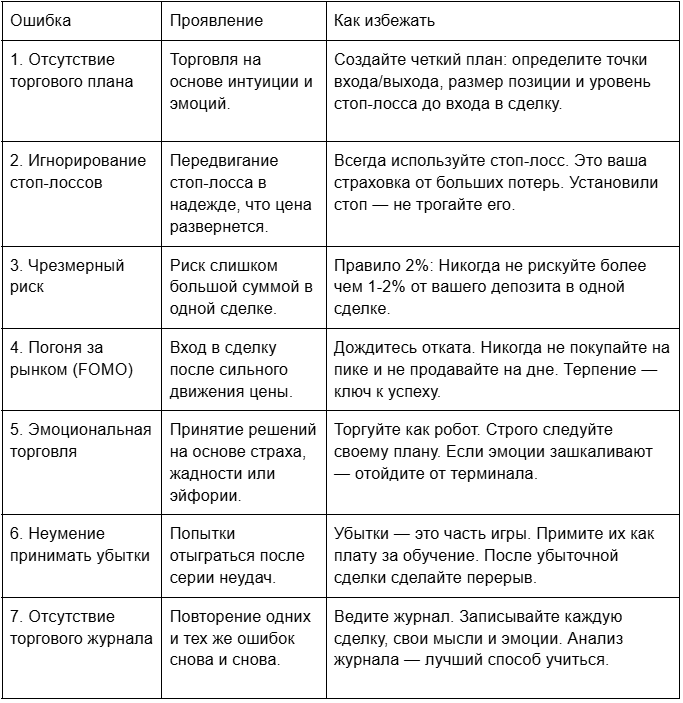
7 Typical Trader Mistakes and How to Avoid Them
Practical Steps to Emotional Stability
Managing emotions is a skill that can and should be developed.
1. Develop and adhere to a trading plan. It's your primary shield against emotional decisions. Your plan should be written down on paper and always in sight.
2. Reduce your position size. The simplest way to lower stress levels is to trade smaller volumes. When you are not risking a sum whose loss would be catastrophic, you can make more balanced decisions.
3. Keep a trading journal. Record not only trade parameters but also your emotions at the time of executing them. This will help you identify your weak spots and work on them.
4. Accept that you cannot control the market. The only thing you can control is yourself: your actions, your risks, and your reaction to events.
5. Take breaks. If you feel tired, irritated, or euphoric, close the trading terminal. Trading in an unstable emotional state is a direct path to losses.
6. Visualize. Before the start of the trading day, imagine not only making a profit but also calmly and disciplinedly closing a losing trade at a stop-loss. This prepares you for any scenario.
Conclusion
Psychology accounts for 80% of success in trading. You can be a brilliant analyst, but if you cannot control your emotions, the market will ruin you. Working on psychological resilience is an ongoing process. Develop discipline, manage risks, and remember that your main goal is not to earn a million in one day but to stay in the game for the long haul.

Calls within Tajikistan are free
Information




The information provided is for informational purposes only and should not be considered as an offer to buy or sell foreign currency, securities and/or other financial instruments. The information presented on this website is not an individual investment recommendation. Financial instruments or transactions mentioned in this section may not be suitable for you, may not correspond to your investment profile, financial situation, investment experience, knowledge, investment objectives, attitude to risk and profitability.
LLC "Exchange Broker" does not guarantee and does not promise future profitability of investments, does not guarantee the reliability of possible investments and the stability of possible income. Investment results in the past do not guarantee income in the future.
LLC "Exchange Broker" is not responsible for possible investor losses in the event of transactions and investments in financial instruments, and also does not guarantee the return, effectiveness and profitability of investments.
LLC "Exchange Broker" hereby informs that it operates in the securities market in accordance with the following professional participant licenses issued by the Ministry of Finance of the Republic of Tajikistan: depository activity No.010/25 dated 25.06.2025; brokerage activity No.007/25 dated 25.06.2025; dealer activity No.008/25 dated 25.06.2025 and securities management activity No.009/25 dated 25.06.2025, and also informs about the risk of a conflict of interest, including as a result of combining various types of professional activity in the securities market.