

 Back
Back
Stocks vs Bonds: What to Choose in 2025?
Introduction
In 2025, investors faced a unique situation in the financial markets. On one hand, after a period of high volatility, the stock market shows mixed trends. On the other hand, the bond market, amidst the beginning of a cycle of key rate cuts, offers attractive yields. Under these conditions, the choice between stocks and bonds becomes especially relevant and requires thorough analysis.
This article is intended for both novice and experienced investors. We will examine in detail what stocks and bonds represent, compare them by key parameters, analyze the market trends of 2025, and provide recommendations for portfolio formation.
What are stocks and bonds?
Before proceeding to comparative analysis, let's refresh the basic concepts.
Stocks
A stock is a security that grants its owner a share in the company's capital and a portion of its profit in the form of dividends. By purchasing a stock, you become a part-owner of the business. An investor's main income comes either from the appreciation of the stock's market value or from dividend payments.
For beginners: Imagine buying a small piece of a large company, such as "Sber" or "Gazprom". If the company performs well, your "piece" becomes more valuable, and you can sell it for a profit. Additionally, the company might share a portion of its profit with you—this is what dividends are.
Advantages of stocks:
High return potential: In the long term, stocks can provide a higher income than bonds.
Inflation protection: A growing company increases its income, which leads to stock value growth that outpaces inflation.
Risks of stocks:
High volatility: Stock prices can fluctuate significantly depending on various factors, from the company's financial performance to general market sentiment.
Capital loss risk: In case of the company’s bankruptcy, shareholders get paid last, and there is a risk of losing all invested funds.
Bonds
A bond is a debt security. By purchasing a bond, you are essentially lending money to a company or government (issuer) at a certain interest rate. The issuer undertakes to return the bond's face value at a specified time and periodically pay coupon income.
For beginners: Imagine lending money to a government or a large company. In return, you receive regular interest payments (coupons), and at the bond’s maturity, you receive the full loan amount. It's a more predictable and less risky investment compared to stocks.
Advantages of bonds:
Predictable income: Coupon payments and face value are known in advance.
Low risk: Bonds, especially government bonds (OFZ), are considered among the most reliable instruments.
Risks of bonds:
Credit risk: The risk that the issuer will not be able to meet its obligations (default).
Interest rate risk: When interest rates rise in the economy, prices for already issued bonds with a fixed coupon fall.
Comparative analysis: stocks vs bonds in 2025
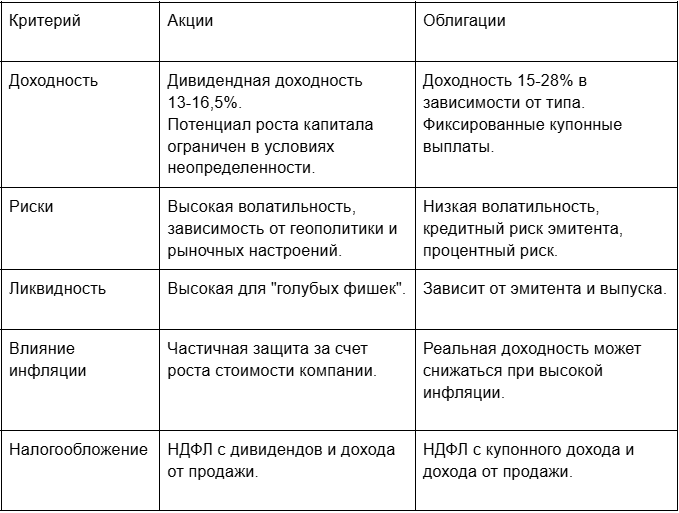
For clarity, let's compare the key characteristics of stocks and bonds in the context of 2025 in the table.
Market trends of 2025
Stock market
In 2025, the Russian stock market showed weak dynamics. The MOEX Index, the main market indicator, either remained unchanged or even showed a slight decline by year-end. This is due to high uncertainty in the economy and geopolitical tensions. Nonetheless, certain sectors and companies demonstrated growth, which opened opportunities for targeted investments.
Bond market
On the contrary, the bond market became the main beneficiary of 2025. The start of the key rate cut cycle by the Central Bank led to rising bond prices. Investors actively shifted funds from more risky stocks to debt instruments, which is confirmed by the growth of corporate bond total return indices by 25-26%.
Recommendations on bond types:
OFZ (Federal Loan Bonds): Government bonds remain the most reliable instrument. Against the backdrop of key rate cuts, long-term OFZ issues showed good growth.
Corporate bonds: Offer higher yields than OFZ but also carry credit risk. In 2025, bonds of companies from the energy, telecommunications, IT, and oil and gas sectors were considered the most reliable.
Floaters (bonds with a floating coupon): Became a good choice in times of uncertainty, as their coupon yield is tied to the key rate or the RUONIA rate, protecting against interest rate risk.
Recommendations for investors
The choice between stocks and bonds depends on your financial goals, investment horizon, and risk tolerance.
For novice investors: It is recommended to start with less risky instruments. The foundation of the portfolio may consist of OFZ and reliable corporate bonds. A small portion (10-20%) can be allocated to blue-chip stocks for potentially higher returns.
For experienced investors: You can use more complex strategies, including purchasing high-yield bonds (HYB) and second-tier stocks. It is important to conduct a thorough analysis of issuers and actively manage the portfolio.
For conservative investors: The main focus should be on bonds with high credit ratings. The goal is capital preservation and stable income.
For aggressive investors: You can increase the stock portion in the portfolio to 50% or more, betting on the growth of individual companies and sectors. However, high risks should be remembered.
Conclusion
The year 2025 demonstrated that in times of uncertainty, bonds can be a more attractive instrument than stocks due to their predictability and lower volatility. However, this does not mean that stocks should be completely abandoned. The key to successful investing lies in **diversification** — the skillful distribution of capital among different asset classes.
The outlook for the second half of 2025 and early 2026 remains moderately optimistic for the bond market, while the stock market will continue to depend on geopolitical situations and macroeconomic indicators. In any case, it is recommended to consult with a financial advisor before making investment decisions.

Calls within Tajikistan are free
Investments
Information




The information provided is for informational purposes only and should not be considered as an offer to buy or sell foreign currency, securities and/or other financial instruments. The information presented on this website is not an individual investment recommendation. Financial instruments or transactions mentioned in this section may not be suitable for you, may not correspond to your investment profile, financial situation, investment experience, knowledge, investment objectives, attitude to risk and profitability.
LLC "Exchange Broker" does not guarantee and does not promise future profitability of investments, does not guarantee the reliability of possible investments and the stability of possible income. Investment results in the past do not guarantee income in the future.
LLC "Exchange Broker" is not responsible for possible investor losses in the event of transactions and investments in financial instruments, and also does not guarantee the return, effectiveness and profitability of investments.
LLC "Exchange Broker" hereby informs that it operates in the securities market in accordance with the following professional participant licenses issued by the Ministry of Finance of the Republic of Tajikistan: depository activity No.010/25 dated 25.06.2025; brokerage activity No.007/25 dated 25.06.2025; dealer activity No.008/25 dated 25.06.2025 and securities management activity No.009/25 dated 25.06.2025, and also informs about the risk of a conflict of interest, including as a result of combining various types of professional activity in the securities market.